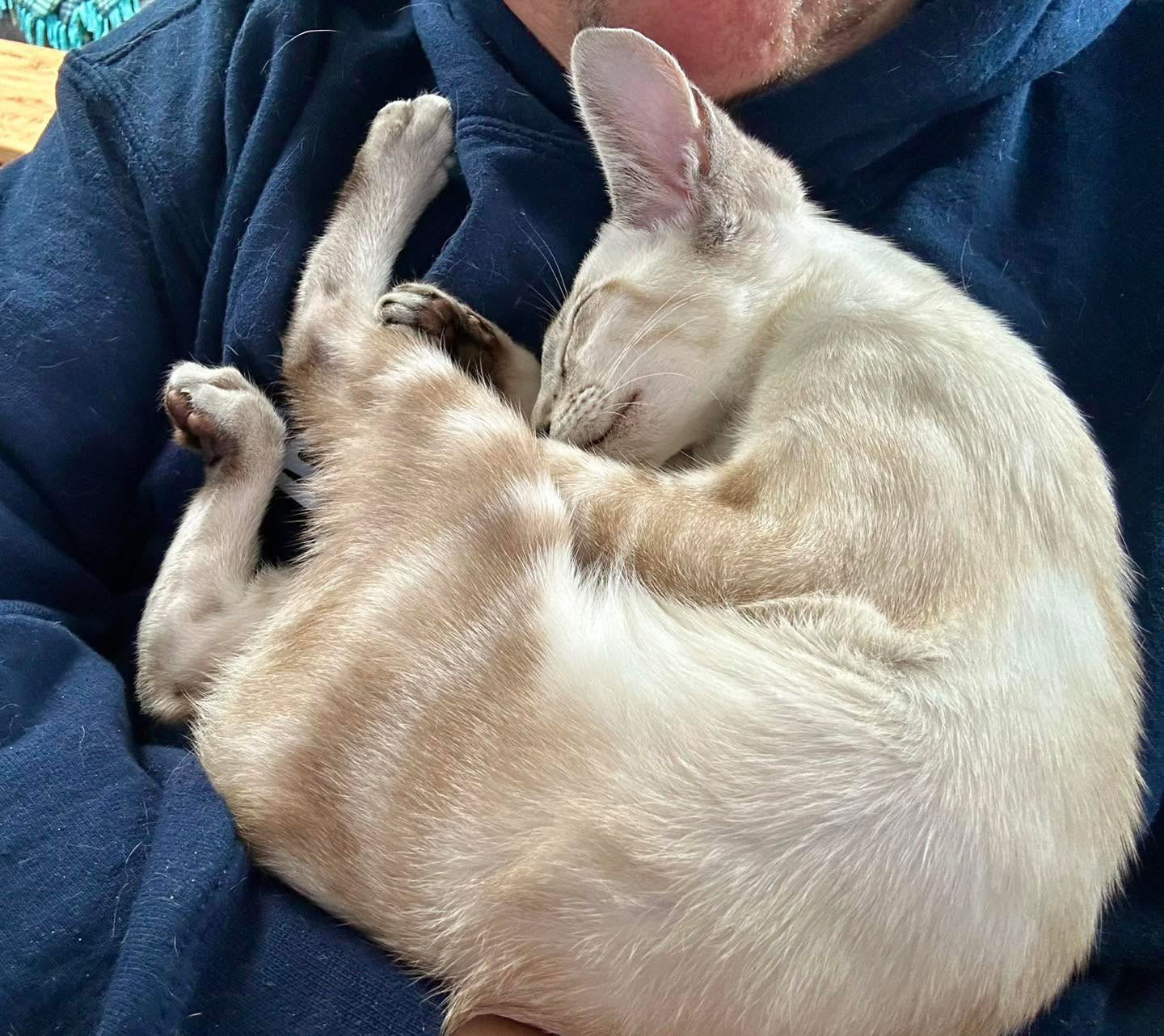
Terry’s father is called “the puppy” because he is constantly trotting instead of walking, constantly talking to himself and everyone, and trying to be part of everything that goes on.
That is not every Oriental Shorthair. It is, however, well within the normal range.
They can be very, very, very noisy
As a breed they can be very, very, very noisy. Even over the white noise of a cat show there’s no question when the Oriental Shorthairs and Siamese are up in a ring.
Individually they range from Vision and Karitsa, who are seldom without commentary, to Sasaki, who can yell for food but generally converses in a hoarse whisper, to Persey, who rarely makes a peep.
If you need a reliably silent cat, selecting the quiet individual helps. Selecting this breed remains an adventurous way to pursue silence.
They want to be involved
They love their people so much that they give little nips as part of social grooming. A sharp “no” suffices if they get out of line. It’s your fault for not having fur to groom everywhere.
Some are very affectionate and very insistent on getting attention, with a great deal of focus and task persistence. They may be fine with being held for hours or playing for hours.
Other Oriental Shorthairs consent to be close without wanting to be grafted to you. Getting a cat to be more cuddly if it’s not in the personality naturally is tough. Your best bet is to be down on the cat’s level, speak softly, do a quiet activity, and let the cat come to you.
Individual personality matters
Margie is a useful example of why individual evaluation matters. Her brother and half-brother are very goofy and cuddly. She’s much more reserved and quite a bit smarter. She’s open to being cuddled and likes to be close, but she’s not as social as either boy.
I dispute that personality by color is anything beyond confirmation bias. A tortie acts out, it must be tortietude… yeah, no. The other cat did that 73 times yesterday and you didn’t say anything.
Color describes the coat. It does not relieve anyone of the need to evaluate the cat.
Socialization matters too
These cats are handled from birth in anticipation of being shown. Even newborns are handled twice a day to be weighed. That, combined with a very intelligent breed with a very social tendency, results in their demeanor.
We spend time socializing and handling them so they’re comfortable with people, understand biting and scratching rules, and don’t become timid or skittish.
Cats at that age are still learning social boundaries. They rely on littermates and mom to teach them when they play too hard. I suggest disengaging for 20 seconds or so with a firm “no” when a kitten bites or claws. They can’t really understand time-outs much longer than that at that age.
Many do better with company
If they’re used to a companion, Oriental Shorthairs tend to do better in groups.
That does not mean every Oriental Shorthair belongs in every group. Some cats are unpredictably aggressive with other cats and should be placed in a single-cat household where they’ll be happy instead of a multi-cat household where they aren’t. Some want a built-in companion. Some want their person to themselves.
Existing animals get a vote
A friendly Oriental Shorthair kitten can still be an exhausting roommate for an elderly cat. Rambunctious is not malicious; the senior may remain unimpressed by that distinction. I would not automatically put a full-throttle kitten with elderly domestic cats and assume everyone will work it out.
I do not trust any cat with small birds. Larger birds may teach a cat respect, but that is not a safety plan. If the bird’s continued existence depends on the cat’s continued self-restraint, the household has drafted the wrong party for compliance.
Children and dogs depend on the actual child, dog, cat, and supervision. “Good with children” is not a magical breed setting.
The household has a personality too
I ask people what they expect in a cat and try not to send the wrong personality to that family. Most cats can adjust, but the whole process is easier when the match is intentional.
I will confess to a certain anxiety when I place a kitten. Even though I ask about the “feel” of the household, and I get a sense of the pace of things—the balance between chaos and order—I can only suggest a kitten based on my imperfect understanding.
I don’t want to inflict a rumpus monster on quiet people who only want a reading buddy, and I don’t want to send a quiet contemplative kitten to a household where the rumpus is a daily tornado.
Before you inquire
An Oriental Shorthair may be right for you if you want a cat who participates, communicates, learns routines, develops strong opinions, and expects a relationship rather than room and board.
Think about the actual household you have: its volume, pace, other animals, absences, tolerance for interruption, and capacity to provide company. Then describe that household honestly.