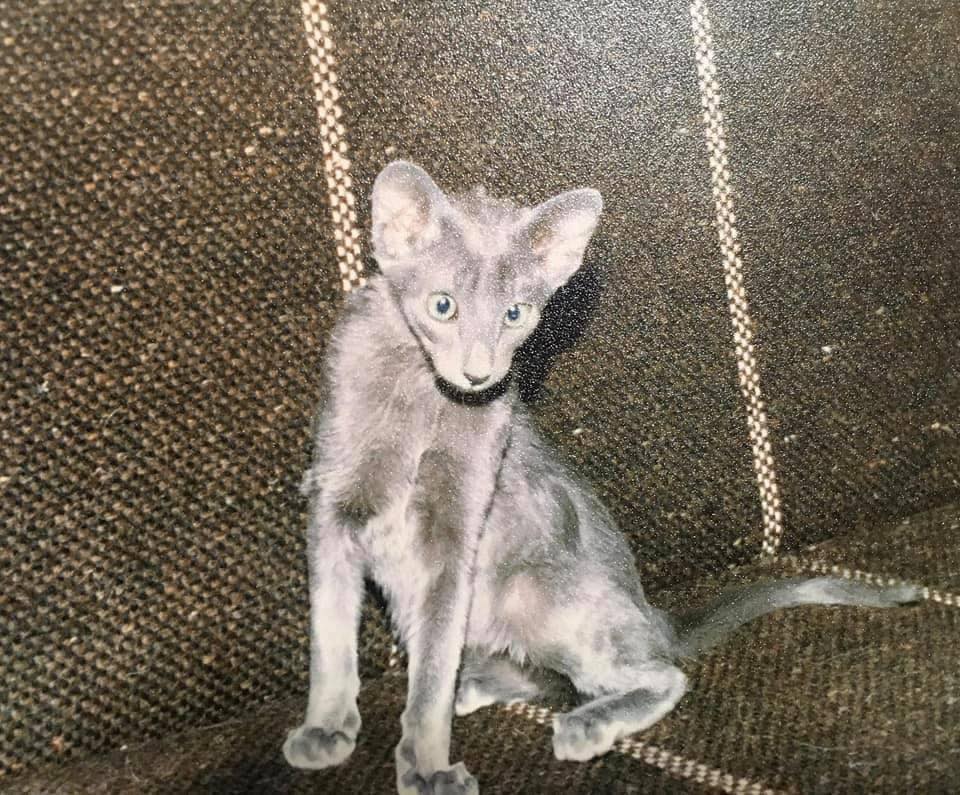
There is no useful reason to invent a temple legend for the Oriental Shorthair. The actual history is better: breeders took the elegant structure and social temperament of the Siamese, added nearly the entire domestic-cat color palette, and then spent generations trying to get the chassis and the paint job right at the same time.
The pedigree is not a creation myth. It is a record of choices.
The full-color relatives of the Siamese
Pointed cats were never the only cats in Thailand, and solid-colored cats of similar ancestry existed alongside them. But the European show fancy eventually defined the Siamese around blue eyes and the pointed pattern. By the late 1920s, solid cats with yellow or green eyes had been excluded from Siamese competition in Britain.
That did not make the genes disappear. The pointed pattern is recessive. A pointed cat can breed true while carrying ancestry from nonpointed cats, and a pair of pointed cats can conceal a great deal of earlier history behind the mask.
The postwar rebuild
World War II devastated European pedigreed-cat populations. In rebuilding the Siamese, British breeders used Russian Blues and other suitable shorthaired cats, then bred back toward Siamese type. Pointed kittens returned quickly. Nonpointed kittens also appeared, carrying the same increasingly refined structure in black, blue, brown, and other colors.
British breeders developed chestnut-brown cats of Siamese type in the 1950s, followed by lavenders, whites, solids, and tabbies. Britain tended to organize these cats as separate breeds according to color. The American project eventually took a different and, to my mind, more sensible approach: one breed, one structural ideal, and an enormous wardrobe.
The American campaign
Several American breeders experimented with solid Siamese-type cats during the 1960s, but scattered experiments do not make a recognized breed. The decisive work began in the early 1970s when Siamese and Colorpoint breeders started coordinating imports, American lines, a standard, and the tedious institutional business of CFA recognition.
Oriental Shorthairs International was organized in 1973. CFA accepted the breed for registration in 1974, advanced it to provisional status in 1975, and approved it for championship competition effective May 1, 1977.
That is startlingly fast by cat-fancy standards. It happened because breeders arrived with a coherent objective and cats that already looked like members of the same breed. They used high-quality American Siamese to improve structure and British or American foundation cats to supply color. The first championship season produced a national-winning Oriental Shorthair. The breed did not shuffle apologetically into the hall.
Color was not an accessory
The point of the Oriental Shorthair was not merely to produce a black Siamese and declare victory. Breeders pursued solids, smokes, silvers, reds, torties, whites, and multiple tabby patterns, later adding still more colors and bicolors.
Every unusual color presented the same problem. A breeder could find the color in a moderate cat, or find extraordinary type in a cat without the color, but getting both into one animal took time. Programs repeatedly outcrossed for structure, concentrated the color again, evaluated the result, and started another generation. Rare colors are not produced by ordering a gene from a catalog and selecting express shipping.
Felitan and the silver Oriental Shorthairs
Barbara and Dick Levitan of Felitan were central to the early American breed and especially to silver. Their program introduced the silver gene through an American Shorthair and then bred repeatedly toward the Oriental Shorthair standard. The early generations brought the usual educational gifts: sterility, uneven type, and kittens that were genetically useful before they were ready for a show ring.
That work eventually produced GC Felitan Silvanna, the first silver Oriental Shorthair to become a Grand Champion, and a silver family that spread through many of the important American programs. Felitan did not hoard every useful non-silver kitten or bury the cats under impossible conditions. Good cats moved to other breeders, and the breed became stronger because the breeders did not treat every pedigree like nuclear launch codes.
Felitan is also part of my family history, not a name I found in an old pedigree. The personal account of Barbara’s mentorship and the years our families spent together belongs in the UltraVires history.
Yes, those Stalcups are my parents
Alex and Janice Stalcup are my parents. My mother’s Temeluphil Cattery joined this foundation period in 1979, and its first litter arrived in January 1980.
Temeluphil became part of that developing silver family. GC Temeluphil’s Bradykininogen and his sister, GC Temeluphil Alia of Earthsea, were early Grand Champions. Brady’s daughter, Temeluphil’s Argent of Glor-ee, became one of the breed’s early Distinguished Merit queens and helped establish the Glor-ee silver line.
My parents also bred CH Temeluphil’s Thromboxane, a blue-silver spotted tabby whose descendants contributed to the early effort to produce shaded-silver Oriental Shorthairs.
This is not pedigree garnish I discovered after starting UltraVires. This is how I entered the breed.
Cooperation made the breed
The foundation history is full of breeders lending studs, placing females on terms, sharing new colors, importing cats together, and allowing useful offspring to leave their own programs. It is also full of failed breedings, sterile cats, accidental colors, and show cats who turned out to have more important work in the breeding room.
That matters because the Oriental Shorthair was not produced by a single cattery or a single theory. It was built as a network. PetMark, Felitan, Sand n’ Sea, San-Toi, Tawnee, Patapaw, RuRu, Seareef, Printer, Temeluphil, Glor-ee, and many others supplied different pieces of the cat now treated as a recognizable whole.
Foundation history is not finished history
This is the breed’s foundation period: the postwar British reconstruction, the American recognition campaign, and the first decades of color and type development through the early 1990s. It is not a claim that the breed stopped changing.
Oriental Longhairs, bicolors, new colors, imported lines, genetic testing, changing show rules, and another thirty years of breeding all came afterward. They deserve their own record. But the foundation explains the breed’s essential character: structurally Siamese, deliberately colorful, genetically candid, and dependent on cooperation among people who did not always agree about anything else.