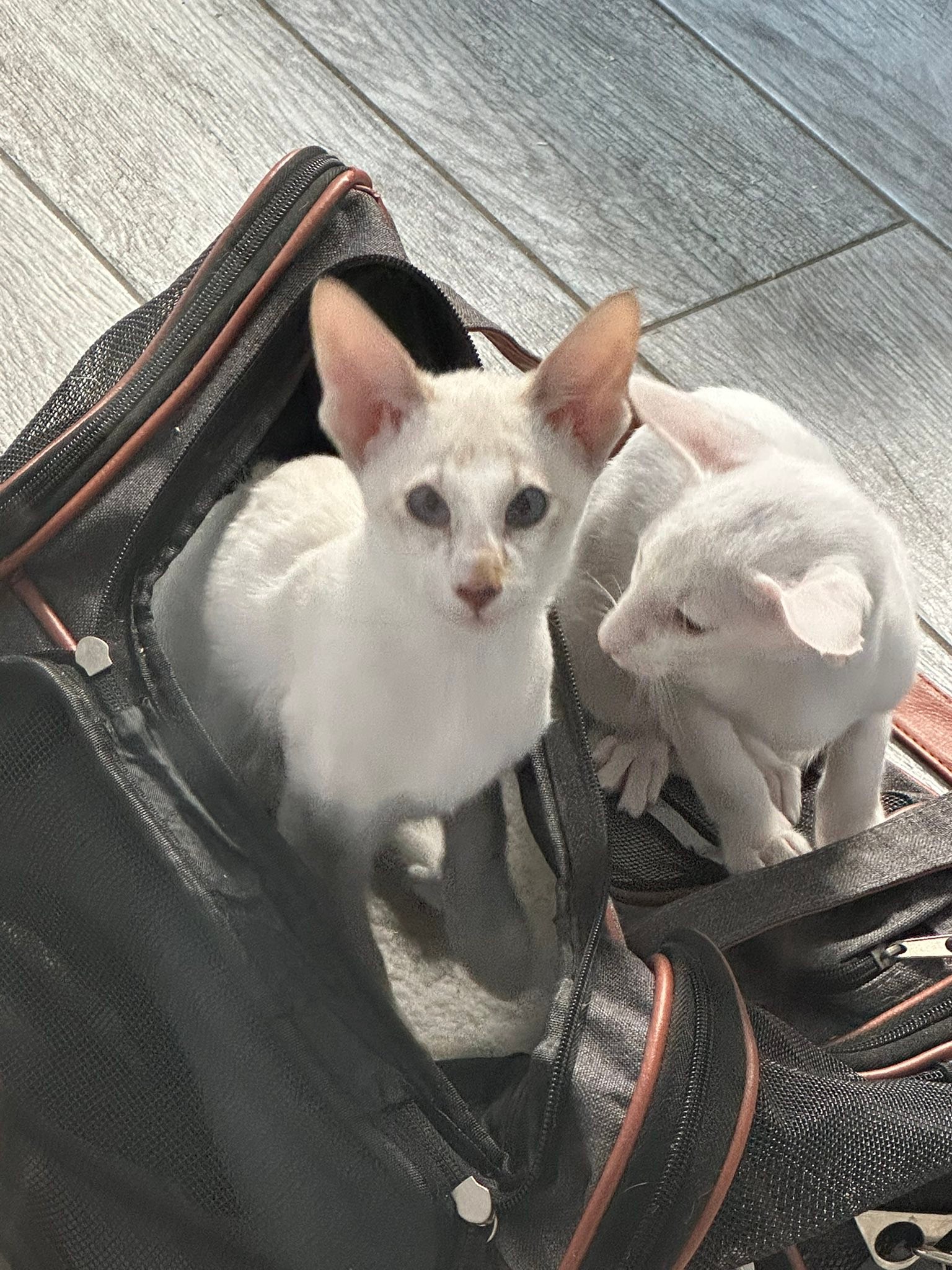
I am a breeder. That gives me experience, records, opinions, and obligations. It does not give me priestly authority or the ability to diagnose somebody else’s cat through a screen.
This page states the tests I use, the health patterns that have affected breeding decisions, and the questions those tools still cannot answer.
Genetic testing is useful. It is not absolution.
Some Oriental Shorthair breeders make a big deal about genetic testing. Let me tell you up front: the things that kill Oriental Shorthairs are not all things we can test for.
There is a test for progressive retinal atrophy, and breeding cats should be tested. But a pet kitten does not need to be separately tested for a recessive condition when the parents’ verified results make the relevant inheritance impossible.
There is no validated predictive test that turns a living Oriental Shorthair into a risk-free biological product. A panel can answer the questions represented on that panel. It cannot answer questions nobody has learned how to ask genetically.
As I wrote in 2023: there’s no test for amyloidosis, no test that predicts the early renal failure I have seen in these cats, and no test for every cancer that may run in a line. Anyone selling you an Oriental Shorthair kitten on the basis of a bunch of tests without explaining those limits is not being completely honest.
“Tested” and “risk-free” are not synonyms.
Pedigrees are longitudinal evidence
I hate the early renal disease that runs in these cats. The fundamental issue is that by the time a cat is six, it may be a great-grandparent on the 12-to-36-month time frame these cats are used for breeding.
If you breed a cat and the pregnancy is difficult, or you have total or nearly total infant mortality, that’s easy. Retire the cat right there.
But a flaw that shows up after the cat is three steps up the pedigree? Tough, tough call.
I’ve openly documented and discussed my issues with idiopathic small-intestine dysfunction, early renal failure, and wasting. It’s been the primary motivating factor in ending some lines and acquiring new genetics.
Families who stay in contact allow a breeder to see how cats age. Those reports are not controlled research, but they can disclose patterns, identify questions, and change which lines continue.
Health information belongs in circulation
I believe health and genetic information should be shared with kitten families and between breeders.
When UC Davis requested to borrow a cat as a control, I took a day off work and Sasaki got an EKG. The useful information is not only the abnormal. Research needs to know what normal looks like too.
If we conceal defects and illnesses from each other, no one learns.
What families should do with uncertainty
If something about the kitten’s health changes, record what you are seeing, call your veterinarian, and tell me. I can supply history and context. The veterinarian examines the kitten.
Bring a chronology, weights if you have them, and photographs or video that show the change. Specific observations are more useful than “he seems off.” Do not pull a dose, drug, feeding schedule, or emergency judgment out of an old story and apply it to a different animal.
A case history can supply context. It cannot examine the kitten in front of you.
Food: I am not a raw-food evangelist
I reject the implication that cats fed commercial food are not being fed a good diet, or that raw is somehow better.
There are no good studies demonstrating that raw or homemade diets are categorically better, or quantifying what superior outcome they supposedly produce. The evidence does show a non-trivial risk of food-borne illness or contamination, along with the possibility of nutritional imbalance, in exchange for benefits nobody has established.
Poultry creates a particular present concern. Freezing and freeze-drying are not reliable substitutes for a validated pathogen-killing step. Cooking it kills pathogens. Then it isn’t raw.
For food, I use a mix of quality dry and wet.
What I can promise
I can promise to disclose what I know, distinguish what I suspect, keep learning from the cats and their families, use testing where it answers a real breeding question, and change course when the lived record of a line tells me to.
I cannot promise that a panel has made uncertainty disappear.